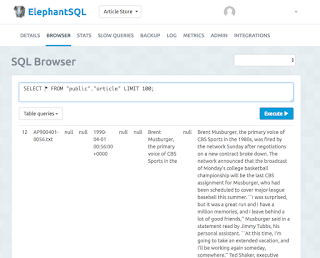
- September 29th, 2017: Friday's #haskell problem uses name-parsing to post parsed names into PostgreSQL database and join them to articles. Today's #haskell solution extracts rows of raw names associated with articles, parses then stores them in PostgreSQL.
- September 28th, 2017: Thursday's #haskell problem inserts reified articles into PostgreSQL database, including names, and throws confetti! Today's #haskell solution inserts the articles from our compressed archive. YAY! Throw confetti!
- September 27th, 2017: Wednesday's #haskell problem looks at parsing names in various formats. Today's #haskell solution solves the name-parsing problem by parsing each name-form in turn.
- September 26th, 2017: Tuesday's #haskell problem looks at staging data on PostgreSQL for deferred processing using Haskell for ETL. Today's #haskell solution transforms RawNames to JSON and uploads it to a staging table on the PostgreSQL database.
- September 25th, 2017: Friday we took a compressed archive and broke that into individual articles. Today we divide articles into sections. Today's #haskell solution uncovers structure bit by bit as we reify an article structure from a block of text.
- September 22nd, 2017: Today's #haskell problem we're going to scan into an 'unstructured' set of documents and start to look for structure. Welp, today's #haskell solution is a 'start': from one blob to 11 blocks of raw text. We'll dig in deeper next week.
- September 21st, 2017: TOMORROW's #haskell problem (announced a wee bit early) queries PostgreSQL database to fetch keyword dictionary state. Today's #haskell solution picks up where we left off yesterday then computes the top keywords across articles.
- September 20th, 2017: Today's #haskell problem asks to push keywords extracted from article onto a PostgreSQL data table. Today's #haskell solution pushes keywords – PUSHES KEYWORDS REAL GOOD – to a PostgreSQL database.
- September 19th, 2017: So we've encoded keywords into Ints, today's #haskell problem decodes those ints back to the keywords. Today's #haskell solution 'reverses the arrows' of the Map, decoding a keyword from an index
- September 18th, 2017: Today's #haskell problem computes the relative word 'strength' of each word in a document. Today's #haskell solution breaks the word-strength problem into small pieces then foldM's over the small pieces.
- September 15th, 2017: Today's #haskell problem takes a look at KEA/Keyword Extraction Algorithm. Ooh, doggies! State IO Map KeyWord something-or-otherfor today's #haskell solution.
- September 14th, 2017: Today's #haskell problem involves using the simple interface to PostgreSQL to insert rows of data. Ooh! Exciting! Today's #haskell solution uses ToRow and ToField to insert Haskell values into #PostgreSQL #DaaS instance! lolneat!
- September 13th, 2017: Today's #haskell problem asks the article names have encoded Julian dates ... OR DO THEY? So, in solving today's #haskell problem, I realized THOSE AREN'T JULIAN DATES! THOSE ARE DATE DATES!
- September 8th, 2017: Continuing our ETL exploration with a load/compress/storefor today's #haskell exercise. Today's #haskell solution shows load/compress/store ... that's a word now.
- September 5th, 2017: Today's #haskell exercise is to build a directory web serviceusing the Snap framework [or a framework you prefer]
- September 4th, 2017: Today's #haskell problem reads in source documents and does some word frequency analyses. Today's #haskell solution shows, surprisingly, 'the' is the most popular English word. Or, not so surprisingly.
- September 1st, 2017: Today's #haskell problem #SPARQL-queries wikidata.org to fetch countries' populations for FB analysis. Yesterday, India won FB by population, today we have a surprise winner in Thailand for FB by percentage user base.
Incorporates strong typing over predicate logic programming, and, conversely, incorporates predicate logic programming into strongly typed functional languages. The style of predicate logic is from Prolog; the strongly typed functional language is Haskell.
Saturday, September 30, 2017
September 2017 1HaskellADay problems and solutions
Tuesday, September 19, 2017
August 2017 1HaskellADay 1Liners Problems and Solutions
- August 1st, 2017: f :: (Maybe a, b) -> Maybe (a, b) Define points-free.
- August 1st, 2017:
Given f above and f a and f b are mutually exclusive in Maybe monad, define
g :: Maybe (a, b) -> Maybe (a, b) -> (Maybe a, b)
points free - August 1st, 2017:
Now, let's define the dual of f
f' :: Maybe (a, b) -> (Maybe a, b)
points free
Friday, September 1, 2017
August 2017 1HaskellADay problems and solutions
- August 31st, 2017: Today's #haskell exercise is by way of @ahnqir. What are the percentage of facebook users by country? Today's #haskell solution charts FB users by country. GO INDIA!
- August 4th, 2017: For today's #haskell problem we are looking at the caesar cipher as a better rot13. And today's #haskell solution with rot, rot, roslein rot everywhere.
- August 1st, 2017: For today's #haskell problem we are parsing a string into word-tokens and munging/demunging them with rot13! WOOT! Munging plaintext and demunging cyphertext, oh, my!
Tuesday, August 1, 2017
July 2017 1HaskellADay 1Liner
- July 7th, 2017:
In LU-decomposition of matrices you have square P-matrix:
[[1,0..],
[0,2,0..],
[0,0,3,0..],
...]
For matrices of n² size
Code that- ∃! David Turner @DaveCTurner
- matrix n = let td = take n . drop 1 in td [td $ replicate i 0 ++ [i] ++ repeat 0 | i <- [0..]]
Monday, July 31, 2017
July 2017 1HaskellADay Problems and Solutions
- July 26th, 2017: We look at unifying fresh variables to ground terms for today's #haskell problem. And we have unification working for free variables and ground terms for today's #haskell solution.
- July 25th, 2017: We look at the beginnings of unification with ground terms for today's #haskell problem. Today's #haskell solution shows unification of ground terms in a monadic domain.
- July 24th, 2017: Commuters today occupy my mind for today's #haskell problem. A little reasoning, a little harsh reality, and we have today's #haskell solution.
- July 20th, 2017: I didn't go for my morning jog, so today's #haskell problem looks at running ... expressions. Eheh. For today's #haskell solution, some people run on empty, but I run on LOGIC! ... same thing.
- July 19th, 2017: Today's #haskell problem is our first step in our scheme to reasoning! MWA-HAHA! via the Reasoned Schemer. Today's #haskell solution:some days are #s; some days are #u
- July 7th, 2017: It's FRIDAY, and you know what that means? SCRABBLE DAY! for today's #haskell problem
- July 6th, 2017: For today's #haskell problem we invert a matrix to solve a system of equations.
- July 5th, 2017: For today's #haskell problem we have a * b = c ... HOW HARD CAN THAT BE? #famouslastwords The #haskell solution took like a whole second! THAT WAS HARD!
- July 4th, 2017: Boys and girls! Gather 'round as I spin you a story of Jemima and Roland for today's #haskell problem.
- July 3rd, 2017: Today's #haskell problem is all 'bout the Ord, 'bout the Ord, 'bout the Ord. No Functor. Today's #haskell solution uses a little sorting logic (not sordid logic; that's different) to show Jim is the eldest.
Friday, July 7, 2017
June 2017 1HaskellADay 1Liners
- June 17th, 2017:
f :: (a, [a]) -> [a] -> [a]
f (c, w1) w2 = c:w1 ++ w2
Define f points-free - bazzargh @bazzargh (++).uncurry(:)
- Felt there must be a nicer way to exploit symmetry of mappend.uncurry(mappend.pure) but can't find it
Monday, July 3, 2017
June 2017 1HaskellADay Problems and Solutions
- June 21st, 2017: Today's #haskell problem connects to and queries a SQL database of your choosing.
- June 16th, 2017: Today's #haskell problem has us interacting with the OS environment in anticipation of SQL database queries. Today's #haskell solution uses Applicative Functors to string together values we collect from the OS environment.
- June 15th, 2017: Today's Haskell problem comes by way of @aisamanra, Mr. Lists-are-Mu-functions-in-the-function-of-Mus. Today's #haskell solution shows Lists are Mu-functors! ... now, making them instances of type-classes, however ...
- June 14th, 2017: Today's #haskell problem is brought by way of @matthieubulte: approximating solutions with Runge-Kutta. The #haskell solution shows I can (ψ, ε, k) with the best of them! AHA! ... but is it the CORRECT solution? 🙄
- June 6th, 2017: In today's #haskell problem, we go clockwise around a binary tree, because ... we've had one too many?
Subscribe to:
Posts (Atom)